
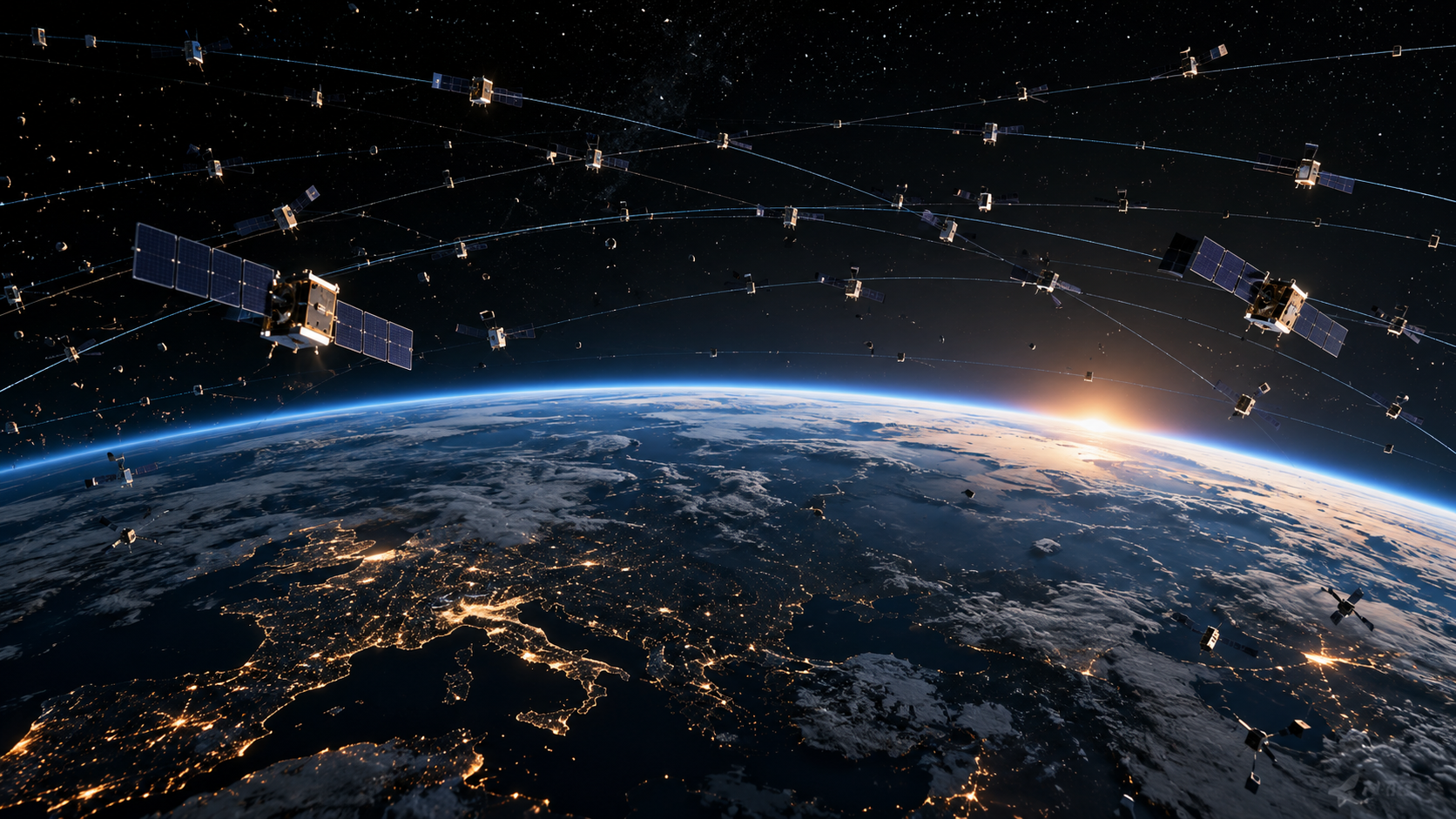
Space used to be treated like a frontier. It is starting to look more like infrastructure.
Satellites now support navigation, weather forecasting, disaster response, financial timing, military targeting, broadband, agriculture, shipping, aviation, mapping, and climate monitoring. When people say "the economy depends on space," they do not mean moon bases. They mean the quiet orbital systems that make ordinary life work.
The strategic question is no longer whether countries can reach space. It is whether they can keep using it safely.
Low Earth orbit is filling up
The OECD reported that more than 14,000 operational satellites were in orbit by the end of 2025, rising to nearly 15,000 by mid-2026. That is a dramatic increase from only a few years earlier, driven largely by low Earth orbit broadband constellations.
The European Space Agency's latest space environment reporting also points to a sharp rise in launch and payload activity, with more than 300 launches and over 4,000 new payloads added to the space environment in 2025.
This is not just growth. It is congestion.
The upside is real
Satellite infrastructure can do things ground networks cannot.
It can bring connectivity to remote areas. It can keep communications running after disasters. It can monitor crops, forests, oceans, methane leaks, ice, fires, and troop movements. It can provide positioning and timing signals to systems that never look like space technology from the outside.
Low Earth orbit constellations also reduce latency compared with traditional geostationary satellite broadband. That makes satellite internet more useful for normal applications.
The result is a more connected planet, especially in places where fiber and cell towers are expensive or politically difficult.
The strategic risk is also real
If satellites become critical infrastructure, then they become targets.
Jamming, spoofing, cyberattacks, dazzling, co-orbital interference, and anti-satellite weapons all become part of the conflict landscape. A country does not need to destroy every satellite to cause trouble. It can interfere with signals, degrade service, or create uncertainty.
Space also blurs the line between civilian and military systems. A commercial imaging satellite can support journalism, agriculture, insurance, and battlefield intelligence. A commercial broadband network can connect rural users and military units.
That dual-use character makes governance hard.
Debris is the shared enemy
The most unforgiving part of space politics is debris.
Objects in orbit move extremely fast. A small fragment can damage or destroy a satellite. Collisions create more debris, which increases the chance of more collisions. Some orbital regions can remain hazardous for years or decades.
This makes space different from many other domains. One actor's bad behavior can pollute the environment everyone needs.
ESA's debris work emphasizes collision avoidance, controlled reentry, passivation, and stricter mitigation rules because the current trajectory cannot be treated casually. The more satellites go up, the more important traffic coordination becomes.
The spectrum problem
Satellites also need radio spectrum. Spectrum is invisible, but it is finite and politically managed.
Mega-constellations require coordination so they do not interfere with one another or with terrestrial networks. Future 5G and 6G systems, fixed satellite services, Earth observation, military communications, and broadband constellations all compete for usable bands and orbital slots.
The politics of space is partly the politics of avoiding collisions. It is also the politics of avoiding interference.
What to watch
The next phase of space geopolitics will be shaped by launch capacity, satellite manufacturing, space situational awareness, debris removal, export controls, spectrum fights, and military doctrine.
The countries and companies that can track objects, maneuver safely, replace satellites quickly, and harden systems against interference will have an advantage.
Space is not becoming important because it is far away. It is becoming important because it is woven into everything below it.
Orbit is now part of the ground.