
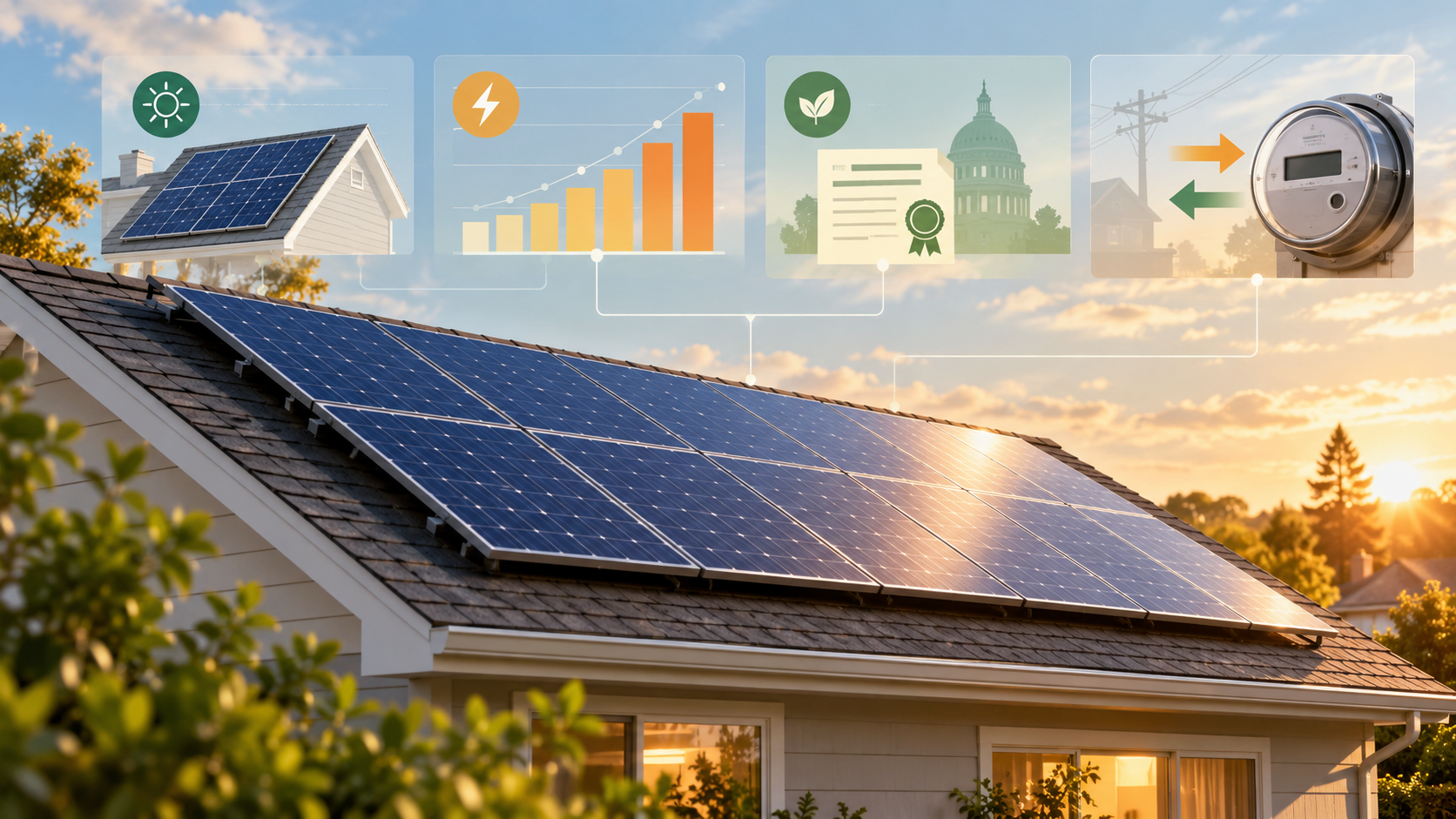
The question "Do solar panels pay for themselves?" sounds simple. It is not.
The honest answer is: sometimes quickly, sometimes slowly, and sometimes not in a way that beats other uses of money. Solar is physical infrastructure, financial product, home improvement, and energy hedge all at once. The details decide everything.
The basic payback idea
A solar payback period is the time it takes for electricity savings to equal the upfront cost of the system.
If a system costs $18,000 after incentives and saves $1,800 per year, the simple payback is ten years. After that, the panels may keep producing electricity for many more years.
Simple payback is useful, but incomplete. It ignores financing costs, maintenance, inverter replacement, electricity inflation, panel degradation, roof work, and what else you could have done with the money.
Electricity prices matter most
Solar is more valuable where grid electricity is expensive. A kilowatt-hour generated on your roof offsets a kilowatt-hour you would otherwise buy.
This is why the same system can look excellent in one state and mediocre in another. Sunlight matters, but utility rates and billing rules often matter more.
Net metering changes the math
Net metering is the policy that determines how much credit you get for electricity you send back to the grid. If exported power is credited near the retail rate, rooftop solar becomes much more attractive. If exported power is credited at a lower wholesale-like rate, the payback can stretch.
This is also where batteries enter the conversation. A battery can store midday solar for evening use, but it adds a lot of cost. In some places a battery improves resilience more than it improves financial return.
Roofs are not spreadsheets
A perfect solar roof faces the right direction, has little shade, has enough area, and does not need replacement soon. Real roofs are messier.
Shade from a chimney, tree, dormer, or neighboring building can reduce output. A roof that needs replacement in five years can make installation more expensive because panels may need to be removed and reinstalled.
Before thinking about payback, think about the roof as a work site.
The system size question
Bigger is not always better. A system sized to cover 100% of annual electricity use may look elegant on paper, but the economics depend on when the power is produced and how exported electricity is credited.
If your utility pays little for excess midday generation, oversizing the system can reduce returns. If net metering is generous, a larger system may make more sense. If you plan to buy an EV or switch from gas heat to a heat pump, future electricity use may justify extra capacity.
The right size depends on current usage, expected future usage, roof constraints, and billing rules.
Batteries change the goal
Batteries are often sold as part of a solar package, but they solve a different problem. Panels reduce electricity purchases. Batteries add backup power and time-shifting.
In some markets, batteries can improve savings by storing cheap solar power for expensive evening hours. In many homes, the main value is resilience: keeping essentials running during outages.
That is valuable, but it should be priced honestly. A battery can make a solar system feel more complete while lengthening the pure financial payback.
Financing can hide the price
Solar loans, leases, and power purchase agreements can make the monthly payment look attractive. They can also make the total cost harder to understand.
Cash purchase is easiest to analyze, but not everyone wants to tie up that much money. Loans can still make sense, especially when the payment is lower than the electricity savings. Just compare the total financed cost, not only the monthly number.
Questions to ask before signing
Before buying, ask for:
- estimated annual production in kilowatt-hours
- the assumed utility rate and escalation rate
- the net metering or export credit assumption
- cash price and financed price
- equipment brands and warranties
- roof work assumptions
- inverter replacement assumptions
- what happens if production misses the estimate
- whether liens or transfer issues affect home resale
The goal is not to become a solar engineer. It is to make the proposal legible.
The bottom line
Solar can be an excellent investment. It can also be oversold by people who benefit from making the spreadsheet look prettier. The panels are real. The math should be too.