
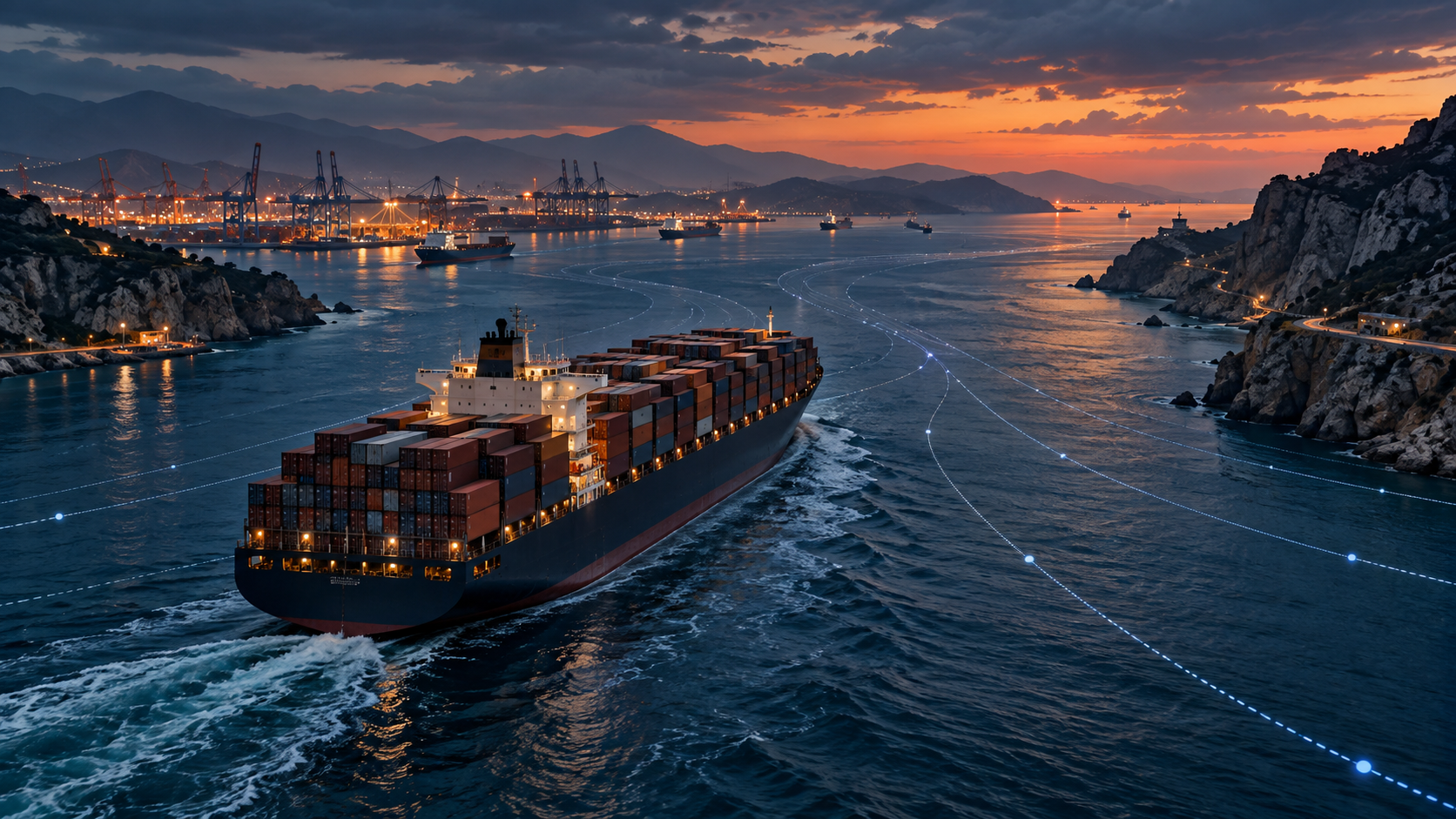
Globalization looks abstract until a ship has to turn around.
Most goods do not move through the air or the internet. They move by sea, inside steel boxes or bulk carriers, through a small number of maritime corridors that make global trade cheap. When those corridors work, the system feels invisible. When they fail, geopolitics appears as higher freight rates, longer delivery times, energy shocks, food-price pressure, and inventory problems.
The fragile points are called chokepoints. They are where geography turns into leverage.
The map is narrower than people think
The world has many ports, but only a few routes connect them efficiently.
The Suez Canal links Europe and Asia without sailing around Africa. The Panama Canal links the Atlantic and Pacific without sailing around South America. The Strait of Hormuz carries a major share of seaborne oil. The Strait of Malacca is one of Asia's key energy and goods arteries. The Bab el-Mandeb links the Red Sea to the Gulf of Aden.
These are not just lines on a map. They are compression points for the world economy.
UN Trade and Development reported that by May 2025, tonnage through the Suez Canal was still 70% below 2023 levels. It also noted that the Strait of Hormuz carries about 11% of global trade and a third of seaborne oil trade.
Those numbers are why naval incidents, droughts, blockages, and port disruptions can become macroeconomic events.
Rerouting is possible, but not free
Shipping is resilient because ships can move. If one route becomes unsafe, vessels can sail around the Cape of Good Hope. If one port is congested, cargo can sometimes move through another.
But rerouting costs time, fuel, insurance, vessel capacity, and schedule reliability.
A longer route absorbs ships that would otherwise be available elsewhere. That tightens capacity and can push up freight rates. Insurance premiums rise when routes are risky. Perishable goods and just-in-time supply chains suffer first.
The system adapts, but adaptation has a price.
Climate is now part of chokepoint risk
Security is not the only problem. Climate pressure is becoming a route risk too.
The Panama Canal depends on freshwater. Drought can reduce the number of vessels allowed through or limit ship draft. That turns rainfall into a trade variable. Heat, storms, and coastal infrastructure stress also affect ports and logistics networks.
The old mental model was that chokepoints were about war and piracy. The newer model includes hydrology.
Geopolitics and climate risk are starting to compound each other.
Why this matters for inflation
Shipping is usually a small share of the final price of many goods. But when freight rates spike quickly, the effect can be uneven and politically visible.
Low-margin goods feel it. Heavy goods feel it. Food, fuel, fertilizer, and basic manufactured inputs can feel it. Developing countries and island economies often face higher transport costs to begin with, so shocks can land harder.
This is why maritime security is not only a defense issue. It is also a cost-of-living issue.
The military layer
Chokepoints attract military attention because they are natural leverage points. A state or armed group does not need to control the whole ocean to disrupt trade. It only needs to threaten a route that many others need.
That changes the balance between cheap attacks and expensive defense. Drones, missiles, mines, and small boats can impose large costs on shipping and naval escorts. The defender has to maintain patrols, intelligence, air defense, and coordination with commercial operators.
The economics favor disruption more than anyone likes.
What resilience looks like
The answer is not one perfect route. It is redundancy.
Better ports, more flexible inventories, diversified suppliers, alternative land corridors, improved canal resilience, smarter routing, and realistic insurance pricing all matter. So does diplomacy that keeps trade routes open before disruption starts.
The smoothness of global trade is not natural. It is maintained.
Every cheap delivery rests on a quiet agreement between geography, security, weather, fuel, labor, and law. Chokepoints are where that agreement becomes visible.