
Microplastics have become one of those topics where the headline arrives before the understanding.
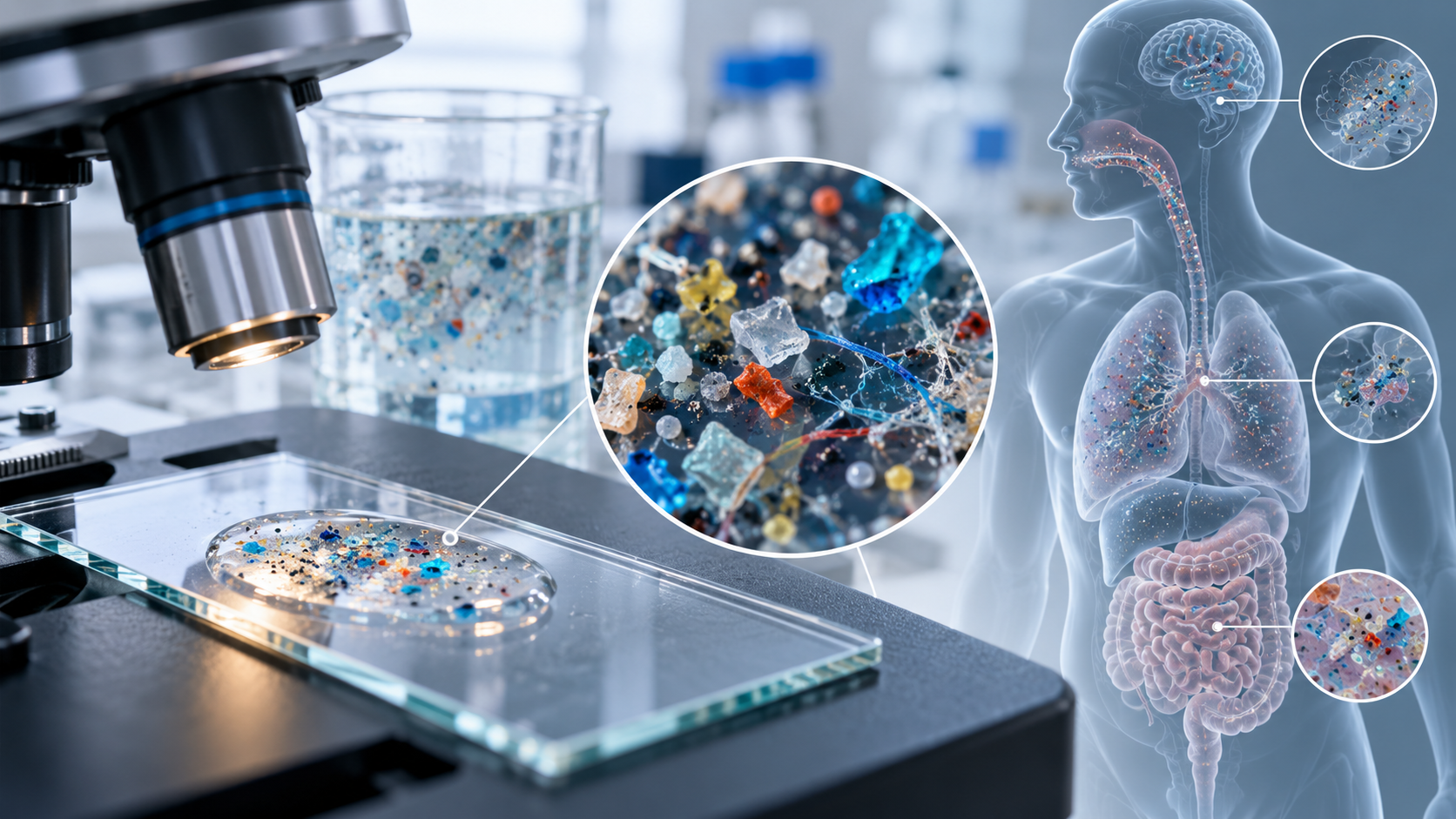
They have been found in oceans, soil, food, bottled water, air, blood, placentas, lungs, and other human tissues. That sounds alarming because it is intimate. Pollution is no longer just "out there." It is inside the body.
But the hard question is not whether microplastics exist. They do. The hard question is what they do at the levels humans actually encounter.
What counts as a microplastic
Microplastics are tiny plastic particles, usually defined as smaller than five millimeters. Nanoplastics are smaller still, sometimes small enough to cross biological barriers more easily.
They come from many sources: synthetic clothing fibers, tire wear, degraded packaging, plastic containers, industrial pellets, paints, and larger plastics breaking down over time. Once plastic fragments are small enough, they become hard to remove from the environment.
Why measurement is difficult
Detecting microplastics in human samples is technically hard. The particles are tiny, contamination is easy, and different studies use different methods. That makes it difficult to compare results directly.
This is why a single scary study rarely settles the issue. Scientists need consistent methods, larger samples, and a clearer picture of dose.
Exposure is real. The exact size of the health risk is still being mapped.
What scientists worry about
There are three broad concerns.
First, the particles themselves may irritate tissue or trigger inflammation. Second, plastics can contain additives such as plasticizers, flame retardants, or stabilizers. Third, plastic particles can carry other chemicals on their surfaces.
Laboratory and animal studies show plausible mechanisms for harm. Human evidence is more limited because it is difficult to separate microplastic exposure from all the other pollution, diet, occupation, and lifestyle factors people experience.
Why headlines can mislead
Microplastic stories often collapse three different questions into one alarming sentence:
- Are particles detectable?
- Are they biologically active?
- Do they cause meaningful disease risk at ordinary exposure levels?
The first answer is clearly yes. The second is plausible and increasingly studied. The third is the hardest, and it is where public discussion often outruns the evidence.
Finding a particle in tissue does not automatically prove disease. At the same time, lack of perfect proof does not mean safety. Environmental health often lives in that uncomfortable middle zone, where the signal is real but the dose-response curve is still being built.
The exposure routes that matter
People encounter microplastics through several routes. Food and water get the most attention, especially bottled water and seafood. Air exposure matters too, because indoor dust can contain fibers from textiles, carpets, furniture, and degraded plastic materials. Tire wear particles are another major source in cities, and they enter air, runoff, soil, and waterways.
This matters because reducing one source does not remove the whole exposure picture. Switching from bottled water to tap water may help in some places, but it does not address indoor dust or road particles. The realistic goal is not purity. It is avoidable reduction.
What would make the evidence stronger
The field needs better standardization. Researchers need consistent sampling methods, better contamination controls, more long-term human studies, and clearer separation between microplastics and nanoplastics. They also need to distinguish polymer types, shapes, sizes, and chemical additives.
A smooth plastic bead is not the same as a jagged fiber. A large particle in the gut is not the same as a tiny particle that may cross into tissue. Treating all microplastics as one category is useful for public awareness but too blunt for risk assessment.
What you can reasonably do
You cannot remove microplastics from modern life. Trying to do so perfectly would become its own kind of stress.
Avoid heating food in plastic containers. Use glass or stainless steel for hot drinks and leftovers. Ventilate when cooking and cleaning. Wash synthetic clothing less aggressively when possible. Reduce single-use plastic where it is easy. Prefer tap water when local water quality is good.
These steps will not make exposure zero. They may reduce some avoidable exposure without turning daily life into a purity ritual.
The bottom line
Microplastics are a real exposure, not a fringe concern. The uncertainty is about magnitude, mechanism, and which exposures matter most. That makes this a public-health and materials problem more than an individual discipline problem.
Better product design, filtration, textile standards, tire materials, waste management, and plastic reduction will matter more than any single household habit.
The honest position is cautious concern: enough evidence to take exposure seriously, not enough to pretend we can precisely rank every personal risk yet.