
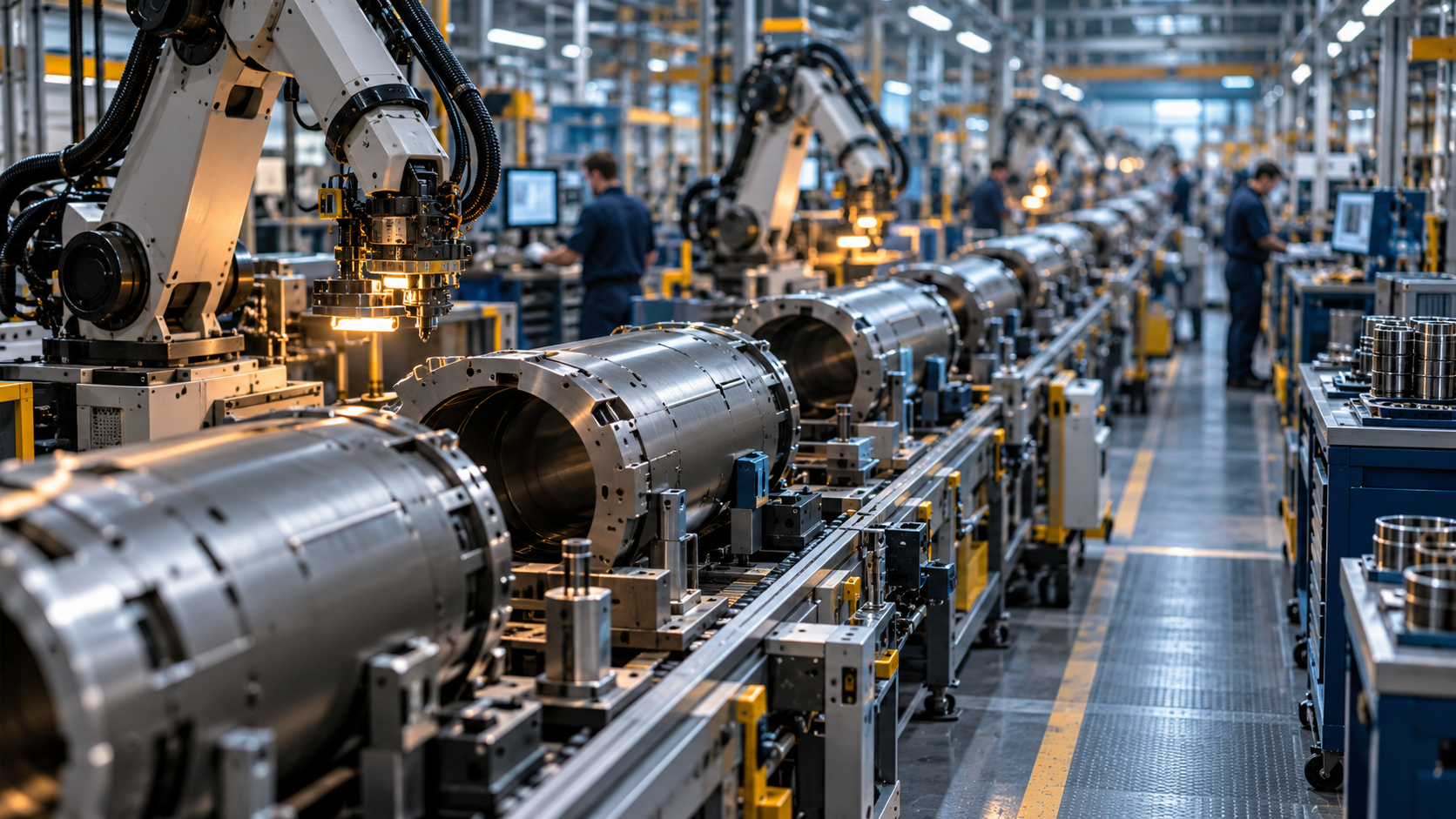
Defense spending is usually discussed as a budget number. The more important question is what the money can actually buy.
That question has become sharper because the world is spending more on defense at the same time that industrial supply chains are more fragile. Ammunition, missiles, drones, shipbuilding, air defense, satellites, secure communications, rare earth magnets, energetic materials, and semiconductors all depend on production capacity that cannot be summoned instantly.
Military power is becoming an industrial-base story again.
The spending trend is clear
SIPRI estimated that world military expenditure reached $2.887 trillion in 2025, up 2.9% in real terms from 2024. It was the 11th consecutive year of growth and the highest level SIPRI has recorded.
The regional pattern matters. SIPRI reported that European military expenditure rose 14% in 2025, while Asia and Oceania rose 8.1%. The 29 European NATO members spent a combined $559 billion, and 22 of them reached at least 2% of GDP under SIPRI's methodology.
Those figures show a political shift. But budget increases do not automatically become usable capability.
Production is the bottleneck
Modern defense systems are slow to build.
A missile may need specialized electronics, rocket motors, explosives, guidance systems, sensors, software, and test ranges. A ship may take years. Air defense interceptors require precision manufacturing. Drones are faster to produce, but effective drone warfare also requires batteries, cameras, radios, chips, software, operators, repair cycles, and counter-drone systems.
The old assumption that countries could order equipment when needed is breaking down. In a prolonged crisis, inventory depth matters as much as platform quality.
Cheap systems changed the math
The rise of drones and loitering munitions has exposed an uncomfortable mismatch.
A relatively cheap drone can force the use of an expensive interceptor. A low-cost maritime drone can threaten a high-value ship. A commercial quadcopter can become part of an artillery targeting loop.
This does not mean traditional platforms are obsolete. It means they need layered defenses and cheaper ways to defeat cheap threats.
The future force is not "all drones" or "all exquisite systems." It is a mix that can afford to fight at scale.
Supply chains are strategic
Defense supply chains overlap with civilian ones.
Chips, batteries, rare earth magnets, machine tools, chemicals, satellite components, cloud infrastructure, and secure software matter to both military and commercial systems. That creates competition for inputs. It also creates vulnerabilities when key suppliers sit outside trusted networks.
This is why defense policy now overlaps with semiconductor policy, critical minerals policy, cyber policy, and energy policy.
The defense industrial base is no longer just prime contractors and shipyards. It includes the industrial substrate beneath them.
Mobilization is hard in rich economies
Many high-income countries let parts of their defense manufacturing base shrink after the Cold War. That was rational when threat perceptions were lower. It becomes a problem when demand rises quickly.
Rebuilding capacity requires long-term contracts. Companies will not expand factories for one short order. Workers need training. Suppliers need confidence. Governments need to coordinate standards and procurement so allies do not all buy incompatible systems.
The slow part of rearmament is not announcing money. It is converting money into factories, tooling, labor, and output.
What to watch next
Look beyond headline budgets.
Watch ammunition production rates, missile backlogs, shipyard capacity, drone procurement, air defense stocks, satellite resilience, maintenance readiness, and allied standardization. Those tell you more about real capacity than a budget announcement does.
Defense spending is rising because governments feel the world becoming more dangerous. The deeper question is whether industrial systems can keep up with that perception.
Power is not just what a country owns. It is what it can keep producing under pressure.