
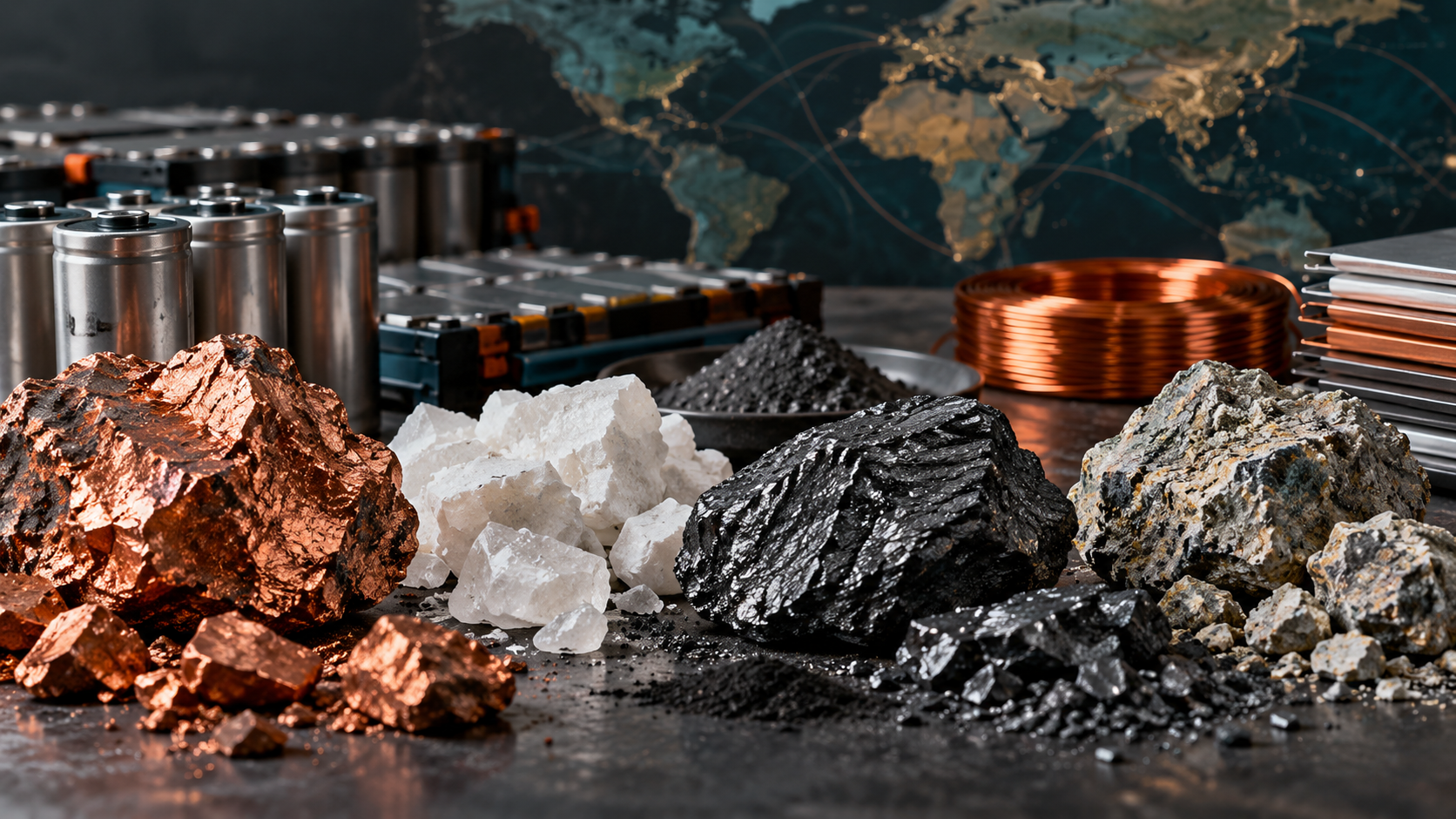
The clean-energy transition did not remove resource politics. It changed the materials.
Oil and gas still matter, but the next layer of industrial competition runs through copper, lithium, nickel, cobalt, graphite, rare earths, gallium, germanium, tungsten, and other strategic inputs. These materials go into batteries, electric vehicles, wind turbines, power grids, semiconductors, military systems, data centers, and consumer electronics.
That makes critical minerals a climate issue, a technology issue, and a geopolitical issue at the same time.
The concentration problem
The big risk is not only that the world needs more minerals. It is that production and processing are concentrated.
UN Trade and Development reported that in 2025 the Democratic Republic of the Congo accounted for 74% of global cobalt mine production, while China produced 78% of the world's natural graphite. The IEA has also warned that, for key energy minerals, the average market share of the top three producers rose to 86% in 2024 from around 82% in 2020.
Concentration is not automatically bad. It can reflect geology, expertise, infrastructure, and investment. But it becomes risky when the same minerals are needed by everyone at once.
If one country dominates processing, it can shape prices, availability, and diplomacy.
Mining is not the only bottleneck
People often focus on mines, but refining can be the tighter choke point.
A country may have mineral deposits and still lack processing capacity. Building mines takes years. Permitting can be slow. Local communities may oppose projects because of water use, tailings, pollution, land rights, or weak benefit-sharing. Processing facilities require technical know-how, stable power, environmental controls, and customers.
This is why "we found a deposit" is not the same as "we solved supply."
The resource has to become a material that manufacturers can actually use.
Demand is pulled by several transitions at once
Critical minerals are not only about electric cars.
Grid expansion requires copper and aluminum. Batteries require lithium, graphite, nickel, manganese, iron, phosphate, or cobalt depending on chemistry. Wind turbines and motors can require rare earth magnets. Semiconductors and defense systems need smaller-volume strategic minerals that can be just as politically sensitive.
AI adds another layer. Data centers require power equipment, cooling systems, chips, backup systems, and grid expansion. Even when AI itself is software, the infrastructure around it is mineral-intensive.
The world is trying to electrify, digitize, automate, and rearm at the same time. That is a lot of demand landing on the same supply chains.
Substitution helps, but not everywhere
Battery chemistry shows how quickly technology can change mineral demand. Lithium iron phosphate batteries have grown sharply because they avoid nickel and cobalt and are cheaper for many uses. Sodium-ion batteries may reduce pressure on lithium in some applications.
But substitution has limits. Copper remains difficult to replace in many electrical uses. Rare earth magnets have performance advantages in compact motors. Strategic minor metals may be needed in tiny amounts but in highly specialized systems.
The future is not one mineral replacing another. It is a constant redesign of materials, supply chains, and industrial policy.
The security question
Governments increasingly treat mineral access as a security issue. That means stockpiles, trade agreements, recycling policy, permitting reform, investment guarantees, export controls, and friend-shoring.
This can improve resilience, but it can also create new tension. Export controls on rare earths or strategic minor minerals can ripple through automakers, defense suppliers, chip companies, and clean-energy manufacturers.
The more strategic a mineral becomes, the less it behaves like a normal commodity.
What a resilient system looks like
A healthier mineral system would have more diverse mining, more diverse refining, better recycling, cleaner extraction, transparent labor standards, and less wasteful product design. It would also include communities in decisions early rather than treating local consent as an obstacle.
The minerals race is not just about digging faster. It is about building supply chains that can survive politics, climate shocks, and demand surprises.
The energy transition is often described as a move away from fuel. That is partly true. But it is also a move toward materials.
And materials have politics.