
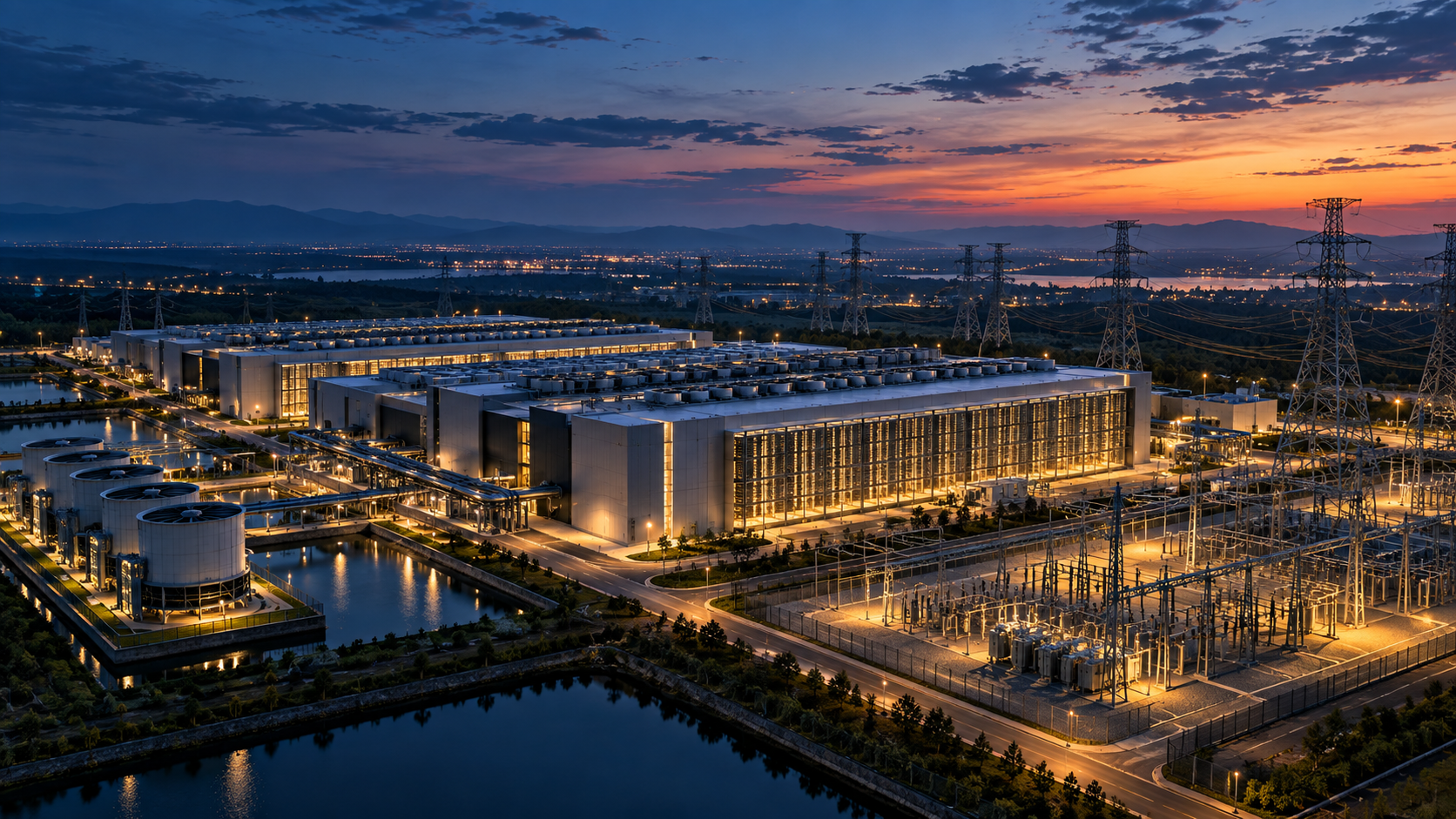
AI used to feel weightless because software feels weightless. You typed a prompt, a model answered, and the physical world disappeared behind the interface.
That illusion is ending.
Training and running AI models requires data centers, chips, transformers, cooling systems, fiber routes, backup power, skilled technicians, and enough electricity to keep the whole machine on. The AI race is still about algorithms, but it is increasingly about infrastructure.
The bottleneck is not only "who has the smartest model?" It is also "who can build the next gigawatt of reliable power near enough to the compute?"
The scale is already visible
The International Energy Agency estimated that global data center electricity demand grew by 17% in 2025, broadly in line with its earlier projections. In its Energy and AI work, the IEA expects data centers to account for less than 10% of global electricity demand growth between 2024 and 2030 in the base case, but that global figure hides much sharper local pressure.
In advanced economies, the same report says data centers are expected to drive more than 20% of electricity demand growth to 2030. That is a very different story for utilities, regulators, and communities trying to connect new loads to already constrained grids.
This is the core paradox: globally, AI may be a manageable share of power growth. Locally, it can be the load that breaks the planning model.
Why the grid cares
A data center is not like a normal office building.
It wants large amounts of power, high reliability, fast interconnection, and often a path to expand. A single campus can require hundreds of megawatts. The largest projects can resemble industrial plants more than technology offices.
That creates three problems.
First, transmission takes time. New power lines and substations can take years to permit and build.
Second, the clean-power accounting is messy. A company may sign renewable contracts, but the local grid may still rely on gas, coal, or imports during real operating hours.
Third, AI demand is uncertain. If model architectures become more efficient, demand could moderate. If inference becomes embedded in every search, office app, phone, and workflow, demand could grow faster than utilities expect.
Water is part of the story
Electricity gets the attention, but cooling matters too.
Data centers use different cooling designs. Some use less water but more electricity. Others use evaporative cooling that can reduce power needs while increasing water consumption. The tradeoff depends on climate, equipment density, and local water stress.
That means "build it where electricity is cheap" is not enough. The best site is a bundle: power, water, latency, tax policy, weather, land, skilled labor, and political tolerance.
AI infrastructure is geography with a balance sheet.
The geopolitical layer
Countries now see compute capacity as strategic infrastructure. The logic is simple: if AI becomes central to defense, biotech, finance, education, logistics, and scientific discovery, then access to compute becomes a national capability.
This is why the AI race touches energy policy, semiconductor export controls, industrial subsidies, cloud sovereignty, and military planning. A country that cannot secure chips, energy, and data center capacity may depend on someone else's AI stack.
That dependency is not theoretical. Cloud regions, model APIs, chip supply chains, and undersea cables already shape who can build what.
AI could also save energy
The story is not only consumption.
AI can help optimize power grids, forecast renewable output, improve building efficiency, detect methane leaks, design materials, and reduce waste in industrial systems. The IEA's broader point is that AI has both energy costs and energy-saving potential.
The problem is timing. Data center demand is concrete and immediate. Efficiency gains across the wider economy are harder to measure, slower to deploy, and depend on adoption outside the technology sector.
So the near-term planning question is blunt: can grids absorb the load before the promised savings arrive?
What to watch next
The useful signal is not just model benchmarks. Watch interconnection queues, power purchase agreements, transformer supply, gas turbine orders, water permits, and data center moratoriums.
Those are the places where the physical AI economy shows up first.
AI may be digital at the point of use, but its expansion is now negotiated in substations, zoning meetings, power markets, and cooling loops.
The next frontier of AI is not only intelligence. It is capacity.